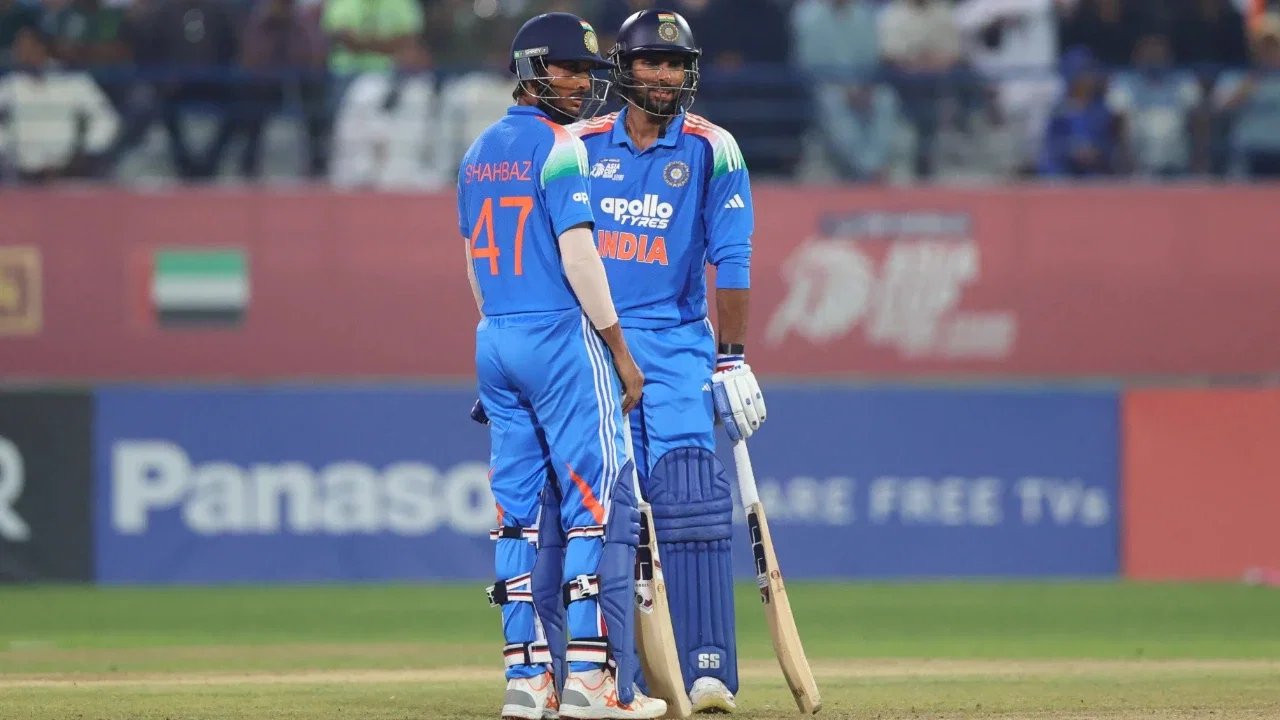
Tilak Varma Names Shahbaz Ahmed’s Dismissal as Turning Point in India A’s Loss to Pakistan Shaheens
India A’s chase came up short in a high-scoring Rising Stars Asia Cup 2026 Group B clash, as Pakistan Shaheens secured a 48-run victory at the West End Park International Cricket Stadium in Doha on November 22. Captain Tilak Varma struck a determined century, but India A were bowled out for 265 in 49.1 overs while pursuing a target of 314.
After the match, Tilak pointed to the dismissal of Shahbaz Ahmed as a decisive moment. The pair had built a promising partnership that briefly put India A in position to challenge Pakistan’s total. Yet Shahbaz’s exit in the 44th over shifted the momentum, leaving Tilak with too much to do and too little support at the other end.
India A’s chase loses momentum after Shahbaz Ahmed departs
India A needed a strong start to keep pace with the required run rate, and Abhishek Sharma provided one. The opener attacked from the outset, scoring 70 from just 42 deliveries and giving the chase early energy. His innings helped India A remain in contention, although the team still had substantial work ahead after Pakistan Shaheens posted 313.
Tilak then anchored the innings, combining patience with calculated aggression. He made 100 from 149 balls, attempting to guide the chase deep and preserve wickets for a late push. Shahbaz’s contribution of 56 from 49 deliveries gave the innings a crucial lift, particularly during a 112-run partnership with Tilak that came from 108 balls.
At 241 for seven in 43.3 overs, however, Shahbaz was dismissed just as India A needed to accelerate. His departure ended the stand and exposed the lower order to mounting pressure. India A could not recover, losing their remaining wickets before reaching the target.
Tilak’s post-match prediction: two more overs could have changed the result
Tilak suggested that Shahbaz’s presence for a little longer might have altered the closing stages. Speaking after the match, he praised both Abhishek’s attacking start and Shahbaz’s partnership, while acknowledging that the timing of the dismissal proved costly.
“The way Abhishek started and, in between, the way Shahbaz put together a partnership with me, that was crucial,” Tilak said, as quoted by NDTV. “But unfortunately, when we wanted to accelerate, Shahbaz got out. Otherwise, if he could have stayed for another two overs or something like that, then I could have finished the game.”
That assessment is a prediction of how the chase might have unfolded, rather than a certainty. With Shahbaz still at the crease, India A would have had another established batter alongside Tilak during a demanding phase. But Pakistan Shaheens had built a substantial total, and India still required a rapid scoring rate. The dismissal mattered because it disrupted a partnership at a critical point—not because the result was guaranteed to change.
Tilak accepts responsibility despite his century
Tilak’s hundred was one of the standout individual performances of the match, but the captain made clear that personal milestones were secondary to the result. He said his aim was to remain at the crease, take the chase as deep as possible and finish the job for India A.
“For me, the best thing is winning the game. If we don’t win the game, then it’s not the best for me,” he said. Tilak added that he had hoped another batter could stay with him, but also accepted the responsibility that comes with leading a side.
“If any other batsman could have given me support, then I could have finished the game. But that’s my thing. If you are the captain of the team, then you should take that load and responsibility. So, yeah, I honestly love doing that,” he said, adding that he was grateful to have scored runs despite the defeat.
His comments reflected the difficult balance facing a captain in a long chase. Tilak had to protect his wicket while also keeping the required rate within reach. His innings gave India A a platform, but the team’s late-wicket collapse meant that the captain’s effort could not be converted into a win.
What the result means for India A
The defeat offers India A several lessons as the Rising Stars Asia Cup continues. Abhishek’s brisk 70 showed the value of an aggressive start, while Tilak and Shahbaz demonstrated that a substantial partnership can bring a demanding target back within reach. The challenge now is to maintain that pressure after a key wicket falls.
Partnerships are especially important in a chase of more than 300. A team may need one batter to anchor the innings and another to keep the scoring rate moving. India A found that balance for a period, but Shahbaz’s dismissal left Tilak without the same level of support during the final push. The lower order was then forced to score quickly against a Pakistan attack defending a sizeable total.
Pakistan Shaheens, meanwhile, will take confidence from their ability to defend 313 and strike at a crucial stage. Their bowlers broke the partnership when India A appeared to be building momentum, then prevented the remaining batters from turning the chase into a close finish.
Key takeaway from the Pakistan Shaheens vs India A match
Tilak Varma’s century and Shahbaz Ahmed’s half-century gave India A a realistic route back into the contest, but the loss of Shahbaz at 241 for seven proved a major setback. India A ultimately fell 48 runs short, despite Abhishek Sharma’s explosive start and the captain’s sustained effort.
For Tilak, the result mattered more than reaching three figures. His post-match remarks placed responsibility on the captain while also highlighting how a single dismissal can reshape a chase. India A will need to turn the promising elements of this performance—early aggression, a strong middle-order stand and determined leadership—into a more complete batting effort in its next Rising Stars Asia Cup fixture.