Glenn Phillips Reveals the Mindset Behind New Zealand’s Day 5 Fightback Against India
New Zealand all-rounder Glenn Phillips said careful planning and patience were central to his approach as the hosts battled through the final day of the first Test against India at Wellington’s Basin Reserve. With the match heading towards a draw, Phillips and Daryl Mitchell shut down India’s hopes of a late breakthrough, surviving a demanding stretch of 258 deliveries together.
Phillips described his pre-match conversation as almost entirely focused on building a practical game plan for a long day at the crease. New Zealand needed to protect their wickets, manage the conditions and use up as much time as possible after India had established a commanding first-innings advantage.
“Ninety-nine per cent of the conversation was pretty much trying to sort the game plan out that I had for the day,” Phillips said after the match. He explained that he had thought about the shots available to him, the positions he needed to get into and how to respond to deliveries that stayed unusually low.
That preparation proved important on a surface where uneven bounce could make even a well-defended ball difficult to judge. Phillips identified the low delivery as a particular concern, and focused on staying balanced and ready rather than committing too early to a shot. His approach reflected the demands of a Test match in which survival, rather than scoring quickly, had become New Zealand’s priority.
Phillips and Mitchell dig in to secure the draw
New Zealand began the final day under pressure after India had declared their first innings at 720 for nine, building a lead of 352 runs. The hosts had scored 368 in reply to India’s imposing total, leaving them with a difficult task: bat for the remainder of the match and prevent the visitors from forcing a result.
The final-day effort was not without setbacks. New Zealand added 120 runs across 75 overs, but India’s bowlers made regular attempts to break through. After the overnight partnership between Devon Conway and Rachin Ravindra had added 72 runs for the third wicket, India found ways to turn pressure into wickets.
Washington Sundar ended Conway’s innings in the 56th over. Conway moved forward to defend, but the ball bounced higher than expected and took an inside edge. Wicketkeeper Rishabh Pant reacted sharply, diving to complete the catch.
Prasidh Krishna then removed Ravindra, who had made 37 from 129 deliveries. Anshul Kamboj claimed the next wicket, dismissing Tom Blundell for 15 after the batter had faced 54 balls. Blundell’s departure came only three overs before the new ball was due, giving India another opportunity to attack with fresh pace and bounce.
Mitchell and Phillips responded by tightening their defence and limiting risk. India created chances, including a missed run-out opportunity when Akash Deep was unable to complete what appeared to be a straightforward dismissal of Mitchell. That moment proved costly as the pair continued to occupy the crease.
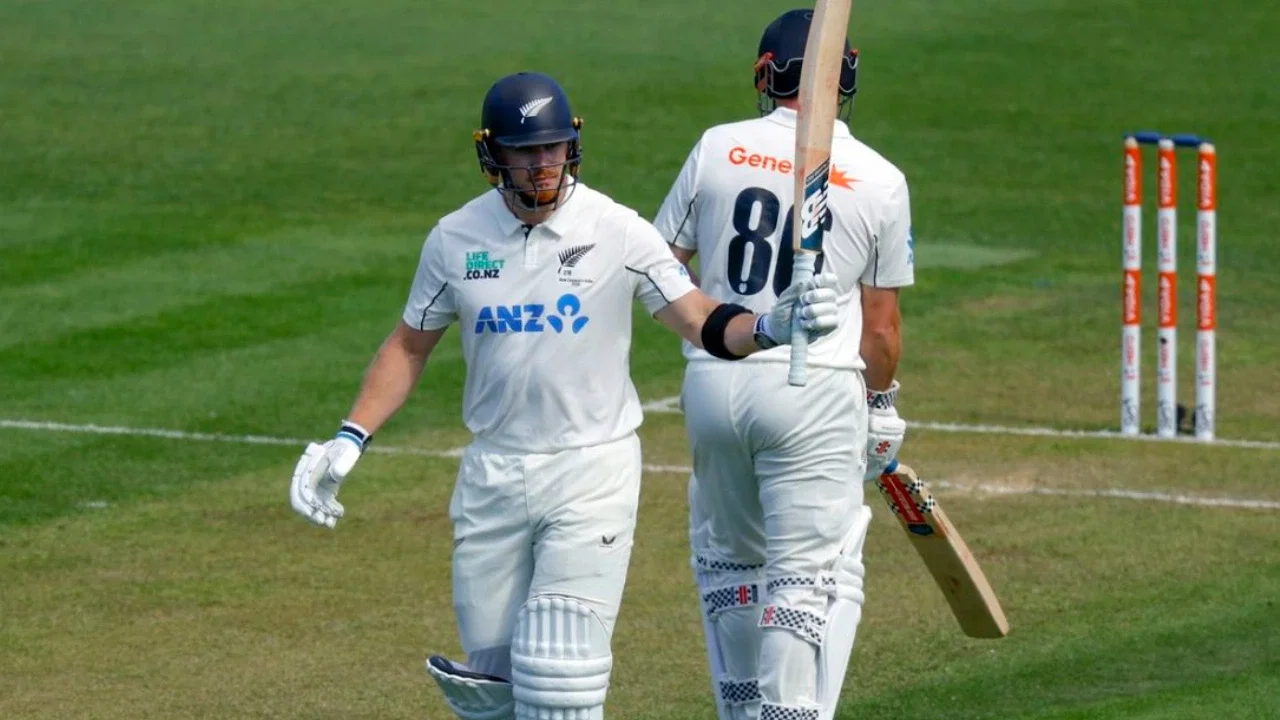
Their unbeaten sixth-wicket stand was worth 63 runs, but its importance lay as much in the time consumed as in the total. Mitchell finished on 49 not out from 186 balls, while Phillips remained unbeaten on 26 from 126 deliveries. Their partnership helped carry New Zealand to 239 for five after 120 overs.
India’s late bowling options and the decision to shake hands
As the final session wore on, scoring became increasingly difficult. New Zealand managed just 33 runs in 24 overs during that period, while India continued searching for a breakthrough. Captain Shubman Gill even turned to part-time options Yashasvi Jaiswal and Dhruv Jurel as the match entered its closing stages.
With more than 15 overs still available but little assistance for the bowlers, the prospect of forcing a result diminished. Gill and the New Zealand batters eventually agreed to end the contest, confirming a draw. The result left the two-match series level at 0-0 and ensured that the second Test would begin without either side holding an advantage.
The finish also offered a clear illustration of how Test cricket can shift from an aggressive contest to a test of concentration and endurance. India had dominated the scoreboard, but New Zealand’s lower-order resistance denied the visitors the final wickets they needed. For the hosts, the draw was built on discipline, judgment and the ability to stay composed under sustained pressure.
Phillips laughs off his serious expression
Alongside his account of the tactical preparation, Phillips joked about the way he appeared during the morning session. Teammate Rob had teased him for looking grumpy, although Phillips said he had not felt unhappy or frustrated at the time.
After seeing a photograph shared by the ACC, he admitted that his expression looked far more intense than he had realised. “Maybe when I’m focused I just look mad,” he said, laughing off the image.
The moment offered a lighter contrast to the concentration required on the field. Phillips’ serious appearance reflected the mental demands of a day spent defending against India’s attack, particularly on a pitch where low bounce required constant attention. His comments also highlighted a broader feature of long-format cricket: players can be calm internally while appearing intensely focused to those watching from the stands.
What the draw means for the series
Phillips’ innings was not defined by a large score, but by the timing and purpose of his contribution. Having scored a century in New Zealand’s first innings, he adapted to a different role on the final day, prioritising defence and partnership-building over attacking strokes. That flexibility is often essential in Test cricket, where a player may need to shift from run-scoring to survival depending on the match situation.
New Zealand’s ability to hold on also gives the series a fresh starting point. India will take confidence from their huge first-innings total and the wickets they secured, while New Zealand can point to the resilience shown by Mitchell, Phillips and their teammates. The result leaves the series open, with the next Test set to determine which side can turn strong passages of play into a decisive win.
For Phillips, the final day was a reminder that a successful prediction of how a pitch will behave is only useful when matched with a clear plan. He anticipated that low deliveries could cause problems, prepared his shot options accordingly and stayed committed to the task. In the end, that preparation helped New Zealand bat long enough to secure the draw.