New Zealand Set Record T20I Total Against India With Stunning 259/7
New Zealand produced a historic batting display against India in the fourth T20I at Eden Park, Auckland, posting 259/7 in 20 overs—the highest T20 International total ever scored against India. The explosive innings surpassed England’s previous record and gave the Black Caps a new benchmark in their own T20I history.
After India captain Shreyas Iyer won the toss and chose to bowl, New Zealand made the most of the conditions and attacked throughout the innings. Powerful hitting in the closing overs pushed the hosts to a total that placed India’s bowlers under immediate pressure and reshaped several statistical records.
New Zealand Surpass England’s Record Against India
England previously held the record for the biggest T20I total against India, having scored 257/3 in Southampton in July 2026. New Zealand moved past that mark with 259/7, finishing two runs ahead after a high-scoring performance at Auckland’s compact Eden Park.
The venue is known for its short boundaries, which can reward batters who find the middle of the bat and target the gaps. But a total of 259 still demands sustained execution: New Zealand combined aggressive stroke play with a strong finish, ensuring that wickets did not prevent them from maintaining a remarkable scoring rate.
New Zealand’s highest T20I totals
The innings also became New Zealand’s highest total in men’s T20I cricket, eclipsing their previous best of 254/5 against Scotland in Edinburgh in 2022. Their other leading totals include 243/5 against the West Indies and 243/6 against Australia, both recorded in 2018.
New Zealand’s record-breaking score against India now sits at the top of that list:
- 259/7 vs India, Auckland — 2026
- 254/5 vs Scotland, Edinburgh — 2022
- 243/5 vs West Indies, Mount Maunganui — 2018
- 243/6 vs Australia, Auckland — 2018
Glenn Phillips Leads the Charge With a 46-Ball Century
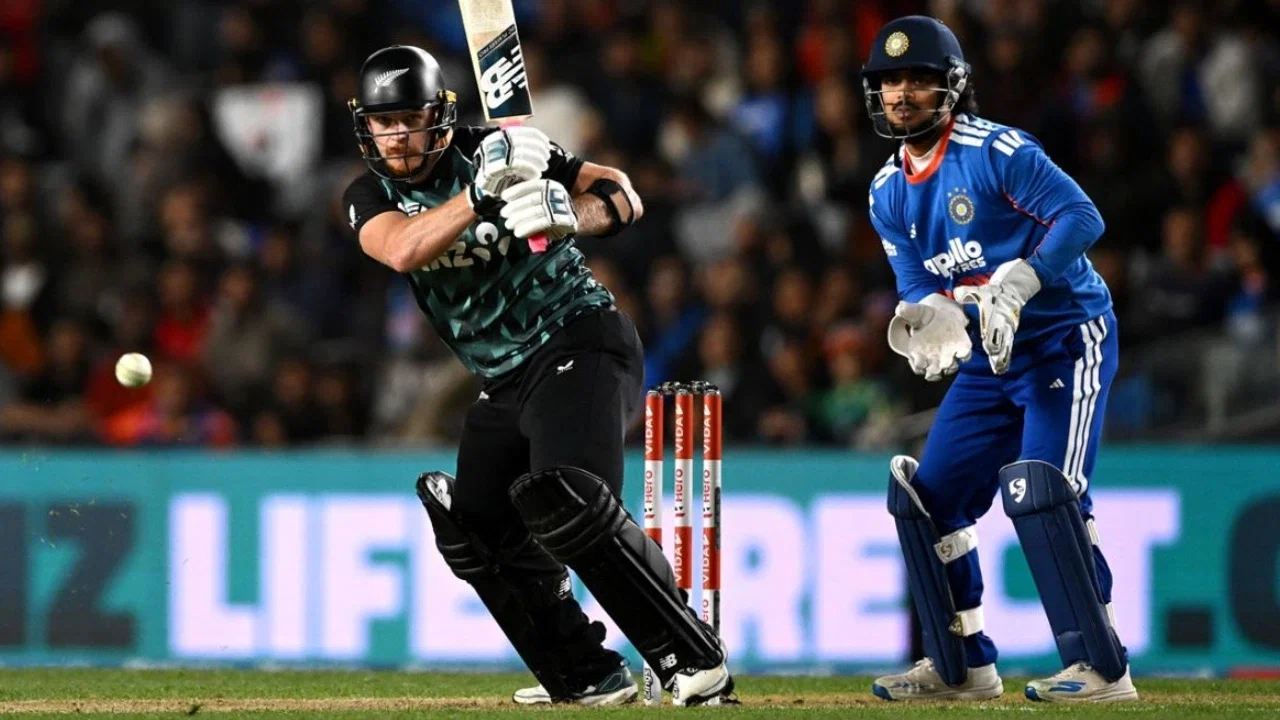
Glenn Phillips was the standout performer, racing to a century from just 46 deliveries. The innings matched his own record for New Zealand’s second-fastest T20I hundred, first achieved against the West Indies in Mount Maunganui in 2020.
Phillips’ knock was built around rapid scoring and calculated aggression. Rather than relying on one scoring area, he found boundaries across the ground, making it difficult for India to settle on a consistent line or length. His innings gave New Zealand momentum, while his ability to accelerate through the middle and late stages helped turn a strong total into a historic one.
Bracewell and Phillips deliver a rapid partnership
Michael Bracewell provided powerful support, smashing 65 from only 25 balls. Together, Phillips and Bracewell added 115 runs from 40 deliveries, a partnership that dramatically lifted New Zealand’s scoring rate.
The stand came at 16.82 runs per over, making it the fastest 100-plus partnership against India in T20I cricket by scoring rate. It also ranked as the fourth-fastest partnership of more than 100 runs against a Full Member team. Such a rate reflects more than boundary-hitting alone: it shows how consistently the batters found scoring options while putting pressure on India’s field placements and bowling plans.
India’s Bowlers Add to an Unwanted 2026 Record
New Zealand’s total also extended an unwelcome trend for India. The team had now conceded 200 or more runs 11 times in T20 cricket during 2026, the highest number recorded by any side in a calendar year. The previous benchmark was nine such totals, shared by Punjab Kings and Rajasthan Royals in 2026.
Repeatedly defending against totals above 200 can expose several challenges for a bowling unit. Captains have fewer low-risk options, mistakes are punished quickly, and even a successful over may not reduce the required scoring rate enough. For India, the Auckland innings underlined the importance of controlling the middle overs and limiting the damage at the death.
New Zealand scored 150 runs in the final 10 overs, the second-highest number India have conceded in the closing half of a T20I innings. India’s most expensive final 10 overs remain the 151 conceded against South Africa in Guwahati in 2022. England’s 146-run finish in Southampton in 2026 ranks third on the list.
Auckland’s Conditions and the Match Prediction Picture
Eden Park’s dimensions often encourage high-scoring cricket, making boundary protection and accurate bowling especially important. On a ground where a well-timed shot can travel over the rope, bowlers need to vary pace, use their yorkers effectively and avoid predictable lengths. New Zealand’s innings showed how quickly a contest can shift when batters combine power with strong timing.
A total of 259/7 naturally gives the batting side a major advantage, but T20 cricket rarely offers certainty. India’s response would depend on a fast start, meaningful partnerships and the ability to keep up with the required rate without losing too many wickets. Any match prediction at such a stage would also need to account for conditions, dew, the state of the pitch and the impact of early breakthroughs.
For New Zealand, the record total offered more than a statistical milestone. It demonstrated the team’s depth and ability to accelerate late in an innings, while Phillips and Bracewell’s partnership highlighted the value of attacking intent in the modern T20 format. For India, the performance provided a clear examination of their bowling plans against aggressive opponents.
Records That Define a Remarkable T20I Innings
New Zealand’s 259/7 brought together several major milestones: the highest T20I score against India, the Black Caps’ highest T20I total, a 46-ball century from Phillips and a rapid 115-run partnership with Bracewell. The innings also added to India’s record number of 200-plus totals conceded in a calendar year.
Whether the match is remembered for Phillips’ century, Bracewell’s explosive support or the sheer scale of New Zealand’s total, the Auckland performance offered a vivid example of how quickly T20 cricket continues to evolve. It raised the bar for teams facing India and gave fans a compelling new reference point for future high-scoring contests.