


India’s Predictions Come True: Mohammed Siraj’s Heroics Against West Indies
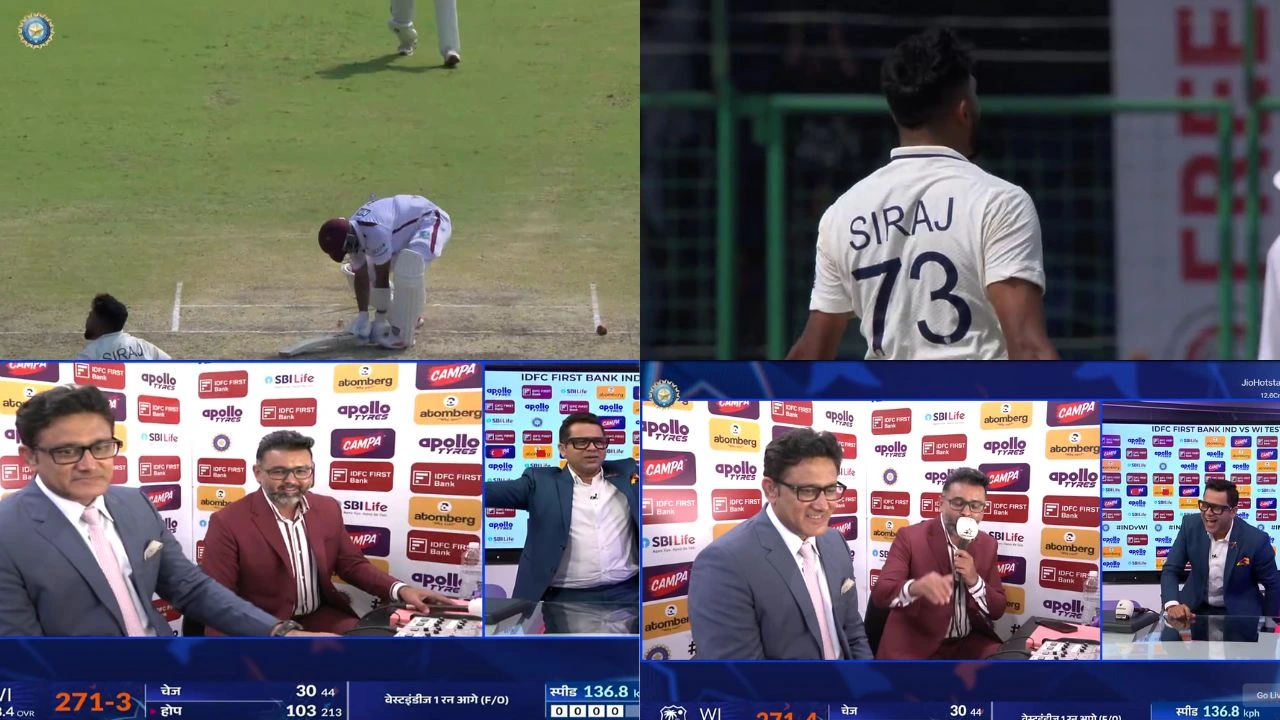
India finally saw a breakthrough on Day 4 of the second and final Test against the West Indies at the Arun Jaitley Stadium in New Delhi. Mohammed Siraj’s timely strike sent Shai Hope back to the pavilion after a superb century, fulfilling former cricketer Aakash Chopra’s prediction while on air with Parthiv Patel and Anil Kumble.
Aakash Chopra’s Accurate Call
On 83.4 overs, Aakash Chopra sensed a wicket was coming, and just one ball later, Mohammed Siraj delivered. On 83.5 overs, Siraj bowled a clever back-of-a-length delivery around off stump that bounced awkwardly, causing Hope to edge it onto his stumps. The West Indies star had to leave after scoring a magnificent 103 runs off 214 balls.
Hope received a standing ovation from the crowd and his team as he walked back. Meanwhile, Mohammed Siraj celebrated with the iconic ‘Siuu CR7’ celebration, signaling India’s much-needed breakthrough.
India’s Review Drama
After a few overs, Mohammed Siraj created another chance for India when Tevin Imlach was struck on the pads by his delivery. The Indian captain reviewed for a possible LBW, but replays showed the ball was missing the stumps, resulting in India losing their review.
However, in the 90th over, Kuldeep Yadav dismissed Imlach for 12. The left-arm wrist-spinner’s delivery stayed straight and hit Imlach’s pads, leading to his dismissal. With this wicket, India now needs just five more wickets to restrict the West Indies to a low score and finish the game on Day 4.
India’s Rare Follow-On
For the first time in 13 years, India enforced a follow-on against the West Indies in the ongoing Delhi Test. The West Indies, currently leading by just 28 runs, managed to avoid an innings defeat. India now aims to wrap up the match quickly to secure a victory on Day 4.
The action-packed Day 4 saw Mohammed Siraj’s heroics fulfilling Aakash Chopra’s prediction, the drama of a failed review, and Kuldeep Yadav’s crucial wicket. As India looks to dominate the final day, the focus is on securing those last five wickets and ensuring a comprehensive victory.
Stay tuned for more updates as India aims to close out the Test with a strong finish against the West Indies.
India’s Dominant Bowling Display
Throughout the match, India’s bowlers have showcased their skills and determination to dismantle the West Indies batting lineup. Players like Mohammed Siraj, Jasprit Bumrah, and Kuldeep Yadav have consistently delivered accurate and impactful performances to put pressure on the visitors.
Mohammed Siraj, in particular, has been in exceptional form, using his pace and variations to trouble the West Indies batsmen. His ability to extract movement off the pitch and maintain a tight line and length has made him a potent threat in Indian conditions.
Jasprit Bumrah, known for his lethal yorkers and deceptive bouncers, has also played a crucial role in building pressure on the opposition. His ability to generate pace and movement off the seam has troubled even the most experienced batsmen in the West Indies lineup.
Meanwhile, Kuldeep Yadav’s left-arm wrist-spin has added a different dimension to India’s bowling attack. His ability to turn the ball both ways and deceive batsmen with his flight and guile has made him a valuable asset in subcontinent conditions.
Importance of Tactical Reviews
The use of the Decision Review System (DRS) in modern cricket has added a new layer of strategy to the game. Captains and players need to make split-second decisions on whether to review an umpire’s call, often relying on technology to provide insights into close calls.
In the case of Mohammed Siraj’s failed LBW review, it highlighted the importance of accurate decision-making under pressure. With only a limited number of reviews available to each team, using them wisely can determine the outcome of a match.
Teams need to balance the risk-reward aspect of reviews, considering factors such as the on-field umpire’s decision, the players’ confidence in the appeal, and the available technology’s reliability. In high-stakes matches like the ongoing Test between India and the West Indies, each review can make a significant difference in the final result.
Historical Significance of India’s Follow-On Decision
Enforcing a follow-on against the West Indies for the first time in 13 years is a significant moment in Indian cricket history. The follow-on rule, which allows the team that batted first to make the opposition bat again if they lead by a significant margin, shows India’s confidence in their bowling attack and desire to secure a comprehensive victory.
By choosing to enforce the follow-on, India’s captain and management displayed their aggressive intent to dominate the match and put the West Indies under immense pressure. This decision also reflects the team’s belief in their ability to bowl out the opposition quickly and wrap up the game within the stipulated time.
As India looks to close out the Test match with a strong finish, the follow-on decision sets the tone for a commanding performance and sends a message to the cricketing world about the team’s ambition and hunger for success.
Conclusion
As the final day of the Test match approaches, India stands on the brink of a well-deserved victory against the West Indies. With the bowlers leading the charge, tactical decisions shaping the course of the game, and historical milestones adding significance to the match, cricket fans around the world are in for an exciting conclusion to this captivating contest.
Stay tuned for more updates as India looks to wrap up the Test match and celebrate a memorable triumph over the West Indies in front of their home crowd.
![[MiKR-066] Sasaki Aki: JAV English Subtitle](https://adultindianporn1.com/wp-content/uploads/2026/02/dci_124914_MiKR-066-Sasaki-Aki-Moodyz-Studio-300x190.jpg)
![[DVMM-345] JAV English Subtitle: Rukawa Rio](https://adultindianporn1.com/wp-content/uploads/2026/02/dci_124916_DVMM-345-Rukawa-Rio-Studio-Deeps-300x190.jpg)
![[FOCS-298] JAV Pornstar Mochizuki Rinne as a Nurse](https://adultindianporn1.com/wp-content/uploads/2026/02/dci_124918_FOCS-298-Focus-Mochizuki-Rinne-300x190.jpg)
![[MiDA-397] Ren Gojo: JAV Nurse English Subtitle](https://adultindianporn1.com/wp-content/uploads/2025/12/dci_124188_mida-397-ren-gojo-jav-nurse-moodyz-300x190.jpg)
![[MMK-263] REN GOJO: JAV English Subtitle](https://adultindianporn1.com/wp-content/uploads/2025/12/dci_124119_MMK-263-JAV-Ren-Gojo-Maoodyz-Studio-300x190.jpg)
![[MiKR-080] Rio Asahi: JAV English Subtitle](https://adultindianporn1.com/wp-content/uploads/2025/12/dci_124121_MiKR-080-JAV-Rio-Asahi-Moodyz-Studio-300x190.jpg)
![[HMN-743] Tojo Natsu: JAV Studio Hon Naka](https://adultindianporn1.com/wp-content/uploads/2025/11/dci_124063_HMN-743-Studio-Hon-Naka-Tojo-Natsu-300x190.jpg)
![[HUNTC-355] JAV Harem: Lucky Guy With 5 Girls](https://adultindianporn1.com/wp-content/uploads/2025/11/dci_124065_HUNTC-455-Studio-Hunter-Harem-300x190.jpg)